Monday, July 6, 2009

Quasars

In the 1960s it was observed that certain objects emitting radio waves but thought to be stars had very unusual optical spectra. It was finally realized that the reason the spectra were so unusual is that the lines were Doppler shifted by a very large amount, corresponding to velocities away from us that were significant fractions of the speed of light. The reason that it took some time to come to this conclusion is that, because these objects were thought to be relatively nearby stars, no one had any reason to believe they should be receding from us at such velocities.

Quasars and QSOs

These objects were named Quasistellar Radio Sources (meaning "star-like radio sources") which was soon contracted to quasars. Later, it was found that many similar objects did not emit radio waves. These were termed Quasistellar Objects or QSOs. Now, all of these are often termed quasars (Only about 1% of the quasars discovered to date have detectable radio emission).

Quasars Are Related to Active Galaxies

The quasars were deemed to be strange new phenomena, and initially there was considerable speculation that new laws of physics might have to be invented to account for the amount of energy that they produced. However, subsequent research has shown that the quasars are closely related to the active galaxies that have been studied at closer distances. We now believe quasars and active galaxies to be related phenomena, and that their energy output can be explained using the theory of general relativity. In that sense, the quasars are certainly strange, but perhaps are not completely new phenomena.

Quasar Redshifts Imply Enormous Distance and Energy Output

The quasars have very large redshifts, indicating by the Hubble law that they are at great distances. The fact that they are visible at such distances implies that they emit enormous amounts of energy and are certainly not stars.

The Energy Source of Quasars is Extremely Compact

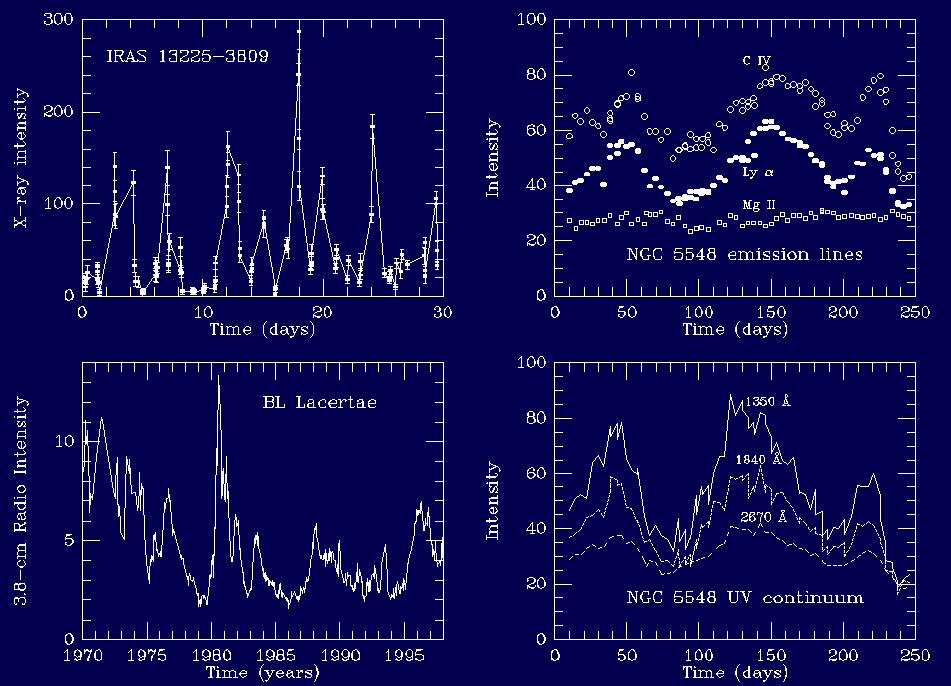
Quasars are extremely luminous at all wavelengths and exhibit variability on timescales as little as hours, indicating that their enormous energy output originates in a very compact source. Here are some light curves at different wavelengths illustrating the variability in intensity of some quasars and other active galaxies. Here is an explanation of these light curves. In all cases, the timescale for variability of the light from an active galaxy sets an upper limit on the size of the compact energy source that powers the active galaxy. These limits are typically the size of the Solar System or smaller.

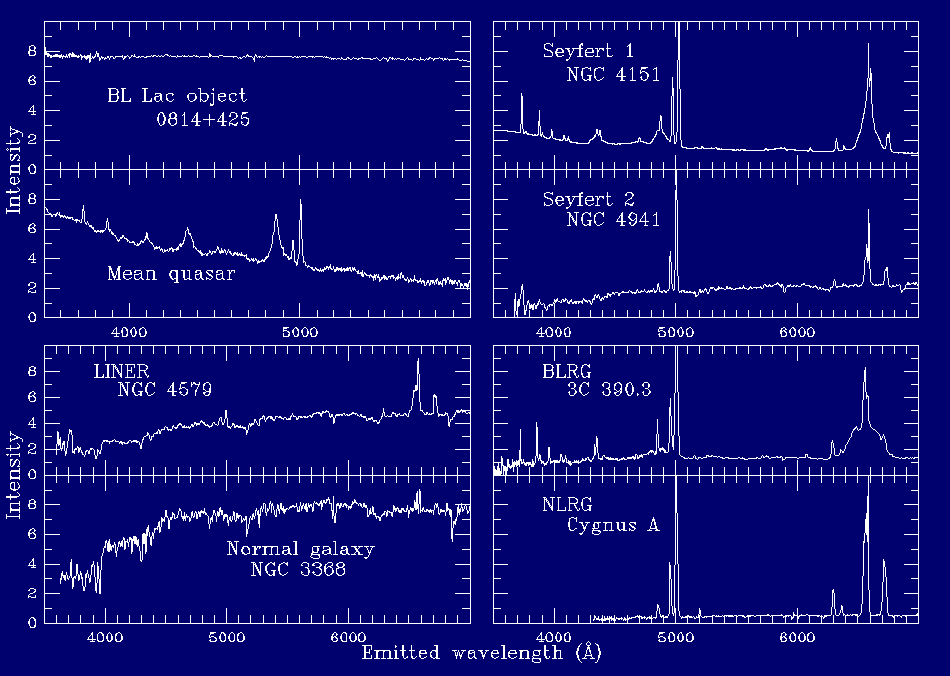
Some quasars emit radio frequency, but most (99%) are radio quiet. Careful observation shows faint jets coming from some quasars. The above images of the quasar 3C273 illustrate both a jet in the optical image on the left and radio frequency emission associated with the jet on the right. Here are some spectra of quasars and other active galaxies - see the following description.

Relationship of Quasars and Active Galaxies

The quasars are thought to be powered by supermassive rotating black holes at their centers. Because they are the most luminous objects known in the universe, they are the objects that have been observed at the greatest distances from us. The most distant are so far away that the light we see coming from them was produced when the Universe was only one tenth of its present age.

The present belief is that quasars are actually closely related to active galaxies such as Seyfert Galaxies or BL Lac objects in that they are very active galaxies with bright nuclei powered by enormous rotating black holes. However, because the quasars are at such large distances, it is difficult to see anything other than the bright nucleus of the active galaxy in their case. As we have noted above, modern observations have begun to detect around some quasars jets and evidence for the surrounding faint nebulosity of a galaxy-like object.

Evolution of Quasars

The standard theory is that quasars turn on when there is matter to feed their supermassive black hole engines at the center and turn off when there is no longer fuel for the black hole. Recent Hubble Space Telescope observations indicate that quasars can occur in galaxies that are interacting with each other. This suggests the possibility that quasars that have turned off because they have consumed the fuel available in the original galaxy may turn back on if the galaxy hosting the quasar interacts with another galaxy in such a way to make more matter available to the black hole. Here is a recent survey of quasar host galaxies that sheds light on this issue.

Abundance of Quasars in the Early Universe

Looking at large distances in the Universe is equivalent to looking back in time because of the finite speed of light. Thus, the observation of quasars at large distances and their scarcity nearby implies that they were much more common in the early Universe than they are now.

This is one piece of evidence that argues against the steady state theory of the Universe but would be consistent with the big bang theory. We shall discuss this further below.

Hungry Black Holes

Notice that the greater abundance of quasars early in the Universe would be consistent with the mechanism discussed above whereby a quasar shuts off when its black hole engine has consumed the fuel available in the host galaxy. We would expect that generally in the early Universe there may have been more mass easily accessible to the black hole than later, after much of it had been consumed. Perhaps later quasars are more dependent on interactions between galaxies to disturb mass distributions and cause galaxies to begin to feed the hungry black hole.

excerpt taken from http://csep10.phys.utk.edu/astr162/lect/active/quasars.html

Sunday, July 5, 2009

Dark Energy

The discovery in 1998 that the Universe is actually speeding up its expansion was a total shock to astronomers. It just seems so counter-intuitive, so against common sense. But the evidence has become convincing.

The evidence came from studying distant type Ia supernovae. This type of supernova results from a white dwarf star in binary system. Matter transfers from the normal star to the white dwarf until the white dwarf attains a critical mass (the Chandrasekhar limit) and undergoes a thermonuclear explosion. Because all white dwarfs achieve the same mass before exploding, they all achieve the same luminosity and can be used by astronomers as "standard candles." Thus by observing their apparent brightness, astronomers can determine their distance using the 1/r2 law.

By knowing the distance to the supernova, we know how long ago it occurred. In addition, the light from the supernova has been red-shifted by the expansion of the universe. By measuring this redshift from the spectrum of the supernova, astronomers can determine how much the universe has expanded since the explosion. By studying many supernovae at different distances, astronomers can piece together a history of the expansion of the universe.

In the 1990's two teams of astronomers, the Supernova Cosmology Project and the High-Z Supernova Search, were looking for distant type Ia supernovae in order to measure the expansion rate of the universe with time. They expected that the expansion would be slowing, which would be indicated by the supernovae being brighter than their redshifts would indicate. Instead, they found the supernovae to be fainter than expected. Hence, the expansion of the universe was accelerating!

In addition, measurements of the cosmic microwave background indicate that the universe has a flat geometry on large scales. Because there is not enough matter in the universe - either ordinary or dark matter - to produce this flatness, the difference must be attributed to a "dark energy". This same dark energy causes the acceleration of the expansion of the universe. In addition, the effect of dark energy seems to vary, with the expansion of the Universe slowing down and speeding up over different times.

Astronomers know dark matter is there by its gravitational effect on the matter that we see and there are ideas about the kinds of particles it must be made of. By contrast, dark energy remains a complete mystery. The name "dark energy" refers to the fact that some kind of "stuff" must fill the vast reaches of mostly empty space in the Universe in order to be able to make space accelerate in its expansion. In this sense, it is a "field" just like an electric field or a magnetic field, both of which are produced by electromagnetic energy. But this analogy can only be taken so far because we can readily observe electromagnetic energy via the particle that carries it, the photon.

Some astronomers identify dark energy with Einstein's Cosmological Constant. Einstein introduced this constant into his general relativity when he saw that his theory was predicting an expanding universe, which was contrary to the evidence for a static universe that he and other physicists had in the early 20th century. This constant balanced the expansion and made the universe static. With Edwin Hubble's discovery of the expansion of the Universe, Einstein dismissed his constant. It later became identified with what quantum theory calls the energy of the vacuum.

In the context of dark energy, the cosmological constant is a reservoir which stores energy. Its energy scales as the universe expands. Applied to the supernova data, it would distinguish effects due to the matter in the universe from those due to the dark energy. Unfortunately, the amount of this stored energy required is far more than observed, and would result in very rapid acceleration (so much so that the stars and galaxies would not form). Physicists have suggested a new type of matter, "quintessence," which would fill the universe like a fluid which has a negative gravitational mass. However, new constraints imposed on cosmological parameters by Hubble Space Telescope data rule out at least simple models of quintessence.

Other possibilities being explored are topological defects, time varying forms of dark energy, or a dark energy that does not scale uniformly with the expansion of the universe.

excerpt taken from http://imagine.gsfc.nasa.gov/docs/science/mysteries_l1/dark_energy.html

Saturday, July 4, 2009

Quantum Cosmology

The physical laws that govern the universe prescribe how an initial state evolves with time. In classical physics, if the initial state of a system is specified exactly then the subsequent motion will be completely predictable. In quantum physics, specifying the initial state of a system allows one to calculate the probability that it will be found in any other state at a later time. Cosmology attempts to describe the behaviour of the entire universe using these physical laws. In applying these laws to the universe one immediately encounters a problem. What is the initial state that the laws should be applied to? In practice, cosmologists tend to work backwards by using the observed properties of the universe now to understand what it was like at earlier times. This approach has proved very successful. However it has led cosmologists back to the question of the initial conditions.

Inflation (a period of accelerating expansion in the very early universe) is now accepted as the standard explanation of several cosmological problems. In order for inflation to have occurred, the universe must have been formed containing some matter in a highly excited state. Inflationary theory does not address the question of why this matter was in such an excited state. Answering this demands a theory of the pre-inflationary initial conditions. There are two serious candidates for such a theory. The first, proposed by Andrei Linde of Stanford University, is called chaotic inflation. According to chaotic inflation, the universe starts off in a completely random state. In some regions matter will be more energetic than in others and inflation could ensue, producing the observable universe.

The second contender for a theory of initial conditions is quantum cosmology, the application of quantum theory to the entire universe. At first this sounds absurd because typically large systems (such as the universe) obey classical, not quantum, laws. Einstein's theory of general relativity is a classical theory that accurately describes the evolution of the universe from the first fraction of a second of its existence to now. However it is known that general relativity is inconsistent with the principles of quantum theory and is therefore not an appropriate description of physical processes that occur at very small length scales or over very short times. To describe such processes one requires a theory of quantum gravity.

In non-gravitational physics the approach to quantum theory that has proved most successful involves mathematical objects known as path integrals. Path integrals were introduced by the Nobel prizewinner Richard Feynman, of CalTech. In the path integral approach, the probability that a system in an initial state A will evolve to a final state B is given by adding up a contribution from every possible history of the system that starts in A and ends in B. For this reason a path integral is often referred to as a `sum over histories'. For large systems, contributions from similar histories cancel each other in the sum and only one history is important. This history is the history that classical physics would predict.

For mathematical reasons, path integrals are formulated in a background with four spatial dimensions rather than three spatial dimensions and one time dimension. There is a procedure known as `analytic continuation' which can be used to convert results expressed in terms of four spatial dimensions into results expressed in terms of three spatial dimensions and one time dimension. This effectively converts one of the spatial dimensions into the time dimension. This spatial dimension is sometimes referred to as `imaginary' time because it involves the use of so-called imaginary numbers, which are well defined mathematical objects used every day by electrical engineers.

The success of path integrals in describing non-gravitational physics naturally led to attempts to describe gravity using path integrals. Gravity is rather different from the other physical forces, whose classical description involves fields (e.g. electric or magnetic fields) propagating in spacetime. The classical description of gravity is given by general relativity, which says that the gravitational force is related to the curvature of spacetime itself i.e. to its geometry. Unlike for non-gravitational physics, spacetime is not just the arena in which physical processes take place but it is a dynamical field. Therefore a sum over histories of the gravitational field in quantum gravity is really a sum over possible geometries for spacetime.

The gravitational field at a fixed time can be described by the geometry of the three spatial dimensions at that time. The history of the gravitational field is described by the four dimensional spacetime that these three spatial dimensions sweep out in time. Therefore the path integral is a sum over all four dimensional spacetime geometries that interpolate between the initial and final three dimensional geometries. In other words it is a sum over all four dimensional spacetimes with two three dimensional boundaries which match the initial and final conditions. Once again, mathematical subtleties require that the path integral be formulated in four spatial dimensions rather than three spatial dimensions and one time dimension.

The path integral formulation of quantum gravity has many mathematical problems. It is also not clear how it relates to more modern attempts at constructing a theory of quantum gravity such as string/M-theory. However it can be used to correctly calculate quantities that can be calculated independently in other ways e.g. black hole temperatures and entropies.

We can now return to cosmology. At any moment, the universe is described by the geometry of the three spatial dimensions as well as by any matter fields that may be present. Given this data one can, in principle, use the path integral to calculate the probability of evolving to any other prescribed state at a later time. However this still requires a knowledge of the initial state, it does not explain it.

Quantum cosmology is a possible solution to this problem. In 1983, Stephen Hawking and James Hartle developed a theory of quantum cosmology which has become known as the `No Boundary Proposal'. Recall that the path integral involves a sum over four dimensional geometries that have boundaries matching onto the initial and final three geometries. The Hartle-Hawking proposal is to simply do away with the initial three geometry i.e. to only include four dimensional geometries that match onto the final three geometry. The path integral is interpreted as giving the probability of a universe with certain properties (i.e. those of the boundary three geometry) being created from nothing.

In practice, calculating probabilities in quantum cosmology using the full path integral is formidably difficult and an approximation has to be used. This is known as the semiclassical approximation because its validity lies somewhere between that of classical and quantum physics. In the semiclassical approximation one argues that most of the four dimensional geometries occuring in the path integral will give very small contributions to the path integral and hence these can be neglected. The path integral can be calculated by just considering a few geometries that give a particularly large contribution. These are known as instantons. Instantons don't exist for all choices of boundary three geometry; however those three geometries that do admit the existence of instantons are more probable than those that don't. Therefore attention is usually restricted to three geometries close to these.

Remember that the path integral is a sum over geometries with four spatial dimensions. Therefore an instanton has four spatial dimensions and a boundary that matches the three geometry whose probability we wish to compute. Typical instantons resemble (four dimensional) surfaces of spheres with the three geometry slicing the sphere in half. They can be used to calculate the quantum process of universe creation, which cannot be described using classical general relativity. They only usually exist for small three geometries, corresponding to the creation of a small universe. Note that the concept of time does not arise in this process. Universe creation is not something that takes place inside some bigger spacetime arena - the instanton describes the spontaneous appearance of a universe from literally nothing. Once the universe exists, quantum cosmology can be approximated by general relativity so time appears.

People have found different types of instantons that can provide the initial conditions for realistic universes. The first attempt to find an instanton that describes the creation of a universe within the context of the `no boundary' proposal was made by Stephen Hawking and Ian Moss. The Hawking-Moss instanton describes the creation of an eternally inflating universe with `closed' spatial three-geometries.

It is presently an unsolved question whether our universe contains closed, flat or open spatial three-geometries. In a flat universe, the large-scale spatial geometry looks like the ordinary three-dimensional space we experience around us. In contrast to this, the spatial sections of a realistic closed universe would look like three-dimensional (surfaces of) spheres with a very large but finite radius. An open geometry would look like an infinite hyperboloid. Only a closed universe would therefore be finite. There is, however, nowadays strong evidence from cosmological observations in favour of an infinite open universe. It is therefore an important question whether there exist instantons that describe the creation of open universes.

The idea behind the Coleman-De Luccia instanton, discovered in 1987, is that the matter in the early universe is initially in a state known as a false vacuum. A false vacuum is a classically stable excited state which is quantum mechanically unstable. In the quantum theory, matter which is in a false vacuum may `tunnel' to its true vacuum state. The quantum tunnelling of the matter in the early universe was described by Coleman and De Luccia. They showed that false vacuum decay proceeds via the nucleation of bubbles in the false vacuum. Inside each bubble the matter has tunnelled. Surprisingly, the interior of such a bubble is an infinite open universe in which inflation may occur. The cosmological instanton describing the creation of an open universe via this bubble nucleation is known as a Coleman-De Luccia instanton.

The Coleman-De Luccia Instanton

Remember that this scenario requires the existence of a false vacuum for the matter in the early universe. Moreover, the condition for inflation to occur once the universe has been created strongly constrains the way the matter decays to its true vacuum. Therefore the creation of open inflating universes appears to be rather contrived in the absence of any explanation of these specific pre-inflationary initial conditions.

Recently, Stephen Hawking and Neil Turok have proposed a bold solution to this problem. They constructed a class of instantons that give rise to open universes in a similar way to the instantons of Coleman and De Luccia. However, they did not require the existence of a false vacuum or other very specific properties of the excited matter state. The price they pay for this is that their instantons have singularities: places where the curvature becomes infinite. Since singularities are usually regarded as places where the theory breaks down and must be replaced by a more fundamental theory, this is a quite controversial feature of their work.

The Hawking-Turok Instanton

The question of course arises which of these instantons describes correctly the creation of our own universe. The way one might hope to distinguish between different theories of quantum cosmology is by considering quantum fluctuations about these instantons. The Heisenberg uncertainty principle in quantum mechanics implies that vacuum fluctuations are present in every quantum theory. In the full quantum picture therefore, an instanton provides us just with a background geometry in the path integral with respect to which quantum fluctuations need to be considered.

During inflation, these quantum mechanical vacuum fluctuations are amplified and due to the accelerating expansion of the universe they are stretched to macroscopic length scales. Later on, when the universe has cooled, they seed the growth of large scale structures (e.g. galaxies) like those we see today. One sees the imprint of these primordial fluctuations as small temperature perturbations in the cosmic microwave background radiation.

Since different types of instantons predict slightly different fluctuation spectra, the temperature perturbations in the cosmic microwave background radiation will depend on the instanton from which the universe was created. In the next decade the satellites MAP and PLANCK will be launched to measure the temperature of the microwave background radiation in different directions on the sky to a very high accuracy. The observations will not only provide us with a very important test of inflation itself but may also be the first possibility to observationally distinguish between different theories for quantum cosmology.

excerpt taken from http://www.damtp.cam.ac.uk/user/gr/public/qg_qc.html

Thursday, July 2, 2009

Why is the sky blue?

It is easy to see that the sky is blue. Have you ever wondered why? A lot of other smart people have, too. And it took a long time to figure it out!

The light from the Sun looks white. But it is really made up of all the colors of the rainbow.

A prism separates white light into the colors of the rainbow.

A prism is a specially shaped crystal. When white light shines through a prism, the light is separated into all its colors.

If you visited The Land of the Magic Windows, you learned that the light you see is just one tiny bit of all the kinds of light energy beaming around the Universe--and around you!

Like energy passing through the ocean, light energy travels in waves, too. Some light travels in short, "choppy" waves. Other light travels in long, lazy waves. Blue light waves are shorter than red light waves.

Different colors of light have different wavelengths.

All light travels in a straight line unless something gets in the way to--

* reflect it (like a mirror)

* bend it (like a prism)

* or scatter it (like molecules of the gases in the atmosphere)

Sunlight reaches Earth's atmosphere and is scattered in all directions by all the gases and particles in the air. Blue light is scattered in all directions by the tiny molecules of air in Earth's atmosphere. Blue is scattered more than other colors because it travels as shorter, smaller waves. This is why we see a blue sky most of the time.

Atmosphere scatters blue light more than other colors.

Closer to the horizon, the sky fades to a lighter blue or white. The sunlight reaching us from low in the sky has passed through even more air than the sunlight reaching us from overhead. As the sunlight has passed through all this air, the air molecules have scattered and rescattered the blue light many times in many directions. Also, the surface of Earth has reflected and scattered the light. All this scattering mixes the colors together again so we see more white and less blue.

What Makes a Red Sunset?

As the Sun gets lower in the sky, its light is passing through more of the atmosphere to reach you. Even more of the blue light is scattered, allowing the reds and yellows to pass straight through to your eyes.

Red sky at sunset

Sometimes the whole western sky seems to glow. The sky appears red because larger particles of dust, pollution, and water vapor in the atmosphere reflect and scatter more of the reds and yellows.

Red sun at sunset.
Why Does Scattering Matter?

How much of the Sun's light gets bounced around in Earth's atmosphere and how much gets reflected back into space? How much light gets soaked up by land and water, asphalt freeways and sunburned surfers? How much light do water and clouds reflect back into space? And why do we care?

Sunlight carries the energy that heats Earth and powers all life on Earth. Our climate is affected by how sunlight is scattered by forests, deserts, snow- and ice-covered surfaces, different types of clouds, smoke from forest fires, and other pollutants in the air.

excerpt taken from http://spaceplace.nasa.gov/en/kids/misrsky/misr_sky.shtml

Friday, June 19, 2009

Nature vs Values

by: Bertrand Russell

The philosophy of nature is one thing, the philosophy of value is quite another. Nothing but harm can come of confusing them. What we think good, what we should like, has no bearing whatever upon what is, which is the question for the philosophy of nature. On the other hand, we cannot be forbidden to value this or that on the ground that the nonhuman world does not value it, nor can we be compelled to admire anything because it is a "law of nature." Undoubtedly we are part of nature, which has produced our desires, our hopes and fears, in accordance with laws which the physicist is beginning to discover. In this sense we are part of nature; in the philosophy of nature we are subordinated to nature, the outcome of natural laws, and their victims in the long run.
The philosophy of nature must be unduly terrestrial; for it, the earth is merely one of the smaller planets of one of the smaller stars of the Milky Way. It would be ridiculous to warp the philosophy of nature in order to bring out results that are pleasing to the tiny parasites of this insignificant planet. Vitalism as a philosophy, and evolutionism, show in this respect, a lack of sense of proportion and logical relevance. They regard the facts of life, which are personally interesting to us, as having a cosmic significance, not a significance confined to the earth's surface. Optimism and pessimism, as cosmoc philosophies, show the same naive humanism; the great world, so far as we know it from the philosophy of nature, is neither good nor bad, and is not concerned to make us happy or unhappy. All such philosophies spring from self-importance and are best corrected by a little astronomy.
But in the philosophy of value the situation is reversed. Nature is only a part of what we can imagine; everything, real or imagined, can be appraised by us, and there is no outside standard to show that our valuation is wrong. We are ourselves the ultimate and irrefutable arbiters of value, and in the world of value nature is only a part. Thus in this world we are greater than nature. In the world of values, nature in itself is neutral, neither good nor bad, deserving of neither admiration nor censure. It is we who create value and our desires which confer value. In this realm we are kings, and we debase our kingship if we bow down to nature. It is for us to determine the good life, not for nature.

Wednesday, June 10, 2009

Edwin Hubble

was born in the small town of Marshfield, Missouri, USA, on November 29th, 1889. In 1898, His family moved to Chicago, where he attended high school. Young Edwin Hubble had been fascinated by science and mysterious new worlds from an early age, having spent his childhood reading the works of Jules Verne (20,000 Leagues Under the Sea, From the Earth to the Moon), and Henry Rider Haggard (King Solomon's Mines), Edwin Hubble was a fine student and an even better athlete, having broken the Illinois State high jump record. When he attended University, Hubble continued to excel in sports such as basketball and boxing, but he also found time to study and earn an undergraduate degree in mathematics and astronomy.

Edwin Hubble went to Oxford University on a Rhodes scholarship, where he did not continue his studies in astronomy, but instead studied law. At this point in his life, he had not yet made up his mind about pursuing a scientific career.

In 1913, Hubble returned from England and was admitted to the bar, setting up a small practice in Louisville Kentucky; but it didn't take long for Hubble to realize he wasn't happy as a lawyer, and that his real passion was astronomy, so he studied at the Yerkes Observatory, and in 1917, received a doctorate in astronomy from the University of Chicago.

Following a tour of duty in the first World War, Hubble took a job at the Mount Wilson Observatory in California, where took many photographs of Cepheid variables through 100 inch reflecting Hooker telescope, proving they were outside our galaxy, and determining the existence of several other galaxies such as our own milky way, which had until then been believed to be the universe.

Hubble had also devised a classification system for the various galaxies he observed, sorting them by content, distance, shape, and brightness; it was then he noticed redshifts in the emission of light from the galaxies, seeing saw that they were moving away from each other at a rate constant to the distance between them. From these observation, he was able to formulate Hubble's Law in 1929, helping astronomers determine the age of the universe, and proving that the universe was expanding.

It is interesting to note that In 1917, Albert Einstein had already introduced his general theory of relativity, and produced a model of space based on that theory, claiming that space was curved by gravity, therefore that it must be able to expand or contract; but he found this assumption so far fetched, that he revised his theory, stating that the universe was static and immobile. Following Hubble's discoveries, he is quoted as having said that second guessing his original findings was the biggest blunder of his life, and he even visited Hubble to thank him in 1931.

excerpt taken from http://www.edwinhubble.com/hubble_bio_001.htm

Monday, June 8, 2009

The Double Helix

The Discovery of the Double Helix, 1951-1953

The discovery in 1953 of the double helix, the twisted-ladder structure of deoxyribonucleic acid (DNA), by James Watson and Francis Crick marked a milestone in the history of science and gave rise to modern molecular biology, which is largely concerned with understanding how genes control the chemical processes within cells. In short order, their discovery yielded ground-breaking insights into the genetic code and protein synthesis. During the 1970s and 1980s, it helped to produce new and powerful scientific techniques, specifically recombinant DNA research, genetic engineering, rapid gene sequencing, and monoclonal antibodies, techniques on which today's multi-billion dollar biotechnology industry is founded. Major current advances in science, namely genetic fingerprinting and modern forensics, the mapping of the human genome, and the promise, yet unfulfilled, of gene therapy, all have their origins in Watson and Crick's inspired work. The double helix has not only reshaped biology, it has become a cultural icon, represented in sculpture, visual art, jewelry, and toys.

Researchers working on DNA in the early 1950s used the term "gene" to mean the smallest unit of genetic information, but they did not know what a gene actually looked like structurally and chemically, or how it was copied, with very few errors, generation after generation. In 1944, Oswald Avery had shown that DNA was the "transforming principle," the carrier of hereditary information, in pneumococcal bacteria. Nevertheless, many scientists continued to believe that DNA had a structure too uniform and simple to store genetic information for making complex living organisms. The genetic material, they reasoned, must consist of proteins, much more diverse and intricate molecules known to perform a multitude of biological functions in the cell.

Crick and Watson recognized, at an early stage in their careers, that gaining a detailed knowledge of the three-dimensional configuration of the gene was the central problem in molecular biology. Without such knowledge, heredity and reproduction could not be understood. They seized on this problem during their very first encounter, in the summer of 1951, and pursued it with single-minded focus over the course of the next eighteen months. This meant taking on the arduous intellectual task of immersing themselves in all the fields of science involved: genetics, biochemistry, chemistry, physical chemistry, and X-ray crystallography. Drawing on the experimental results of others (they conducted no DNA experiments of their own), taking advantage of their complementary scientific backgrounds in physics and X-ray crystallography (Crick) and viral and bacterial genetics (Watson), and relying on their brilliant intuition, persistence, and luck, the two showed that DNA had a structure sufficiently complex and yet elegantly simple enough to be the master molecule of life.

Other researchers had made important but seemingly unconnected findings about the composition of DNA; it fell to Watson and Crick to unify these disparate findings into a coherent theory of genetic transfer. The organic chemist Alexander Todd had determined that the backbone of the DNA molecule contained repeating phosphate and deoxyribose sugar groups. The biochemist Erwin Chargaff had found that while the amount of DNA and of its four types of bases--the purine bases adenine (A) and guanine (G), and the pyrimidine bases cytosine (C) and thymine(T)--varied widely from species to species, A and T always appeared in ratios of one-to-one, as did G and C. Maurice Wilkins and Rosalind Franklin had obtained high-resolution X-ray images of DNA fibers that suggested a helical, corkscrew-like shape. Linus Pauling, then the world's leading physical chemist, had recently discovered the single-stranded alpha helix, the structure found in many proteins, prompting biologists to think of helical forms. Moreover, he had pioneered the method of model building in chemistry by which Watson and Crick were to uncover the structure of DNA. Indeed, Crick and Watson feared that they would be upstaged by Pauling, who proposed his own model of DNA in February 1953, although his three-stranded helical structure quickly proved erroneous.

The time, then, was ripe for their discovery. After several failed attempts at model building, including their own ill-fated three-stranded version and one in which the bases were paired like with like (adenine with adenine, etc.), they achieved their break-through. Jerry Donohue, a visiting physical chemist from the United States who shared Watson and Crick's office for the year, pointed out that the configuration for the rings of carbon, nitrogen, hydrogen, and oxygen (the elements of all four bases) in thymine and guanine given in most textbooks of chemistry was incorrect. On February 28, 1953, Watson, acting on Donohue's advice, put the two bases into their correct form in cardboard models by moving a hydrogen atom from a position where it bonded with oxygen to a neighboring position where it bonded with nitrogen. While shifting around the cardboard cut-outs of the accurate molecules on his office table, Watson realized in a stroke of inspiration that A, when joined with T, very nearly resembled a combination of C and G, and that each pair could hold together by forming hydrogen bonds. If A always paired with T, and likewise C with G, then not only were Chargaff's rules (that in DNA, the amount of A equals that of T, and C that of G) accounted for, but the pairs could be neatly fitted between the two helical sugar-phosphate backbones of DNA, the outside rails of the ladder. The bases connected to the two backbones at right angles while the backbones retained their regular shape as they wound around a common axis, all of which were structural features demanded by the X-ray evidence. Similarly, the complementary pairing of the bases was compatible with the fact, also established by the X-ray diffraction pattern, that the backbones ran in opposite direction to each other, one up, the other down.

Watson and Crick published their findings in a one-page paper, with the understated title "A Structure for Deoxyribose Nucleic Acid," in the British scientific weekly Nature on April 25, 1953, illustrated with a schematic drawing of the double helix by Crick's wife, Odile. A coin toss decided the order in which they were named as authors. Foremost among the "novel features" of "considerable biological interest" they described was the pairing of the bases on the inside of the two DNA backbones: A=T and C=G. The pairing rule immediately suggested a copying mechanism for DNA: given the sequence of the bases in one strand, that of the other was automatically determined, which meant that when the two chains separated, each served as a template for a complementary new chain. Watson and Crick developed their ideas about genetic replication in a second article in Nature, published on May 30, 1953.

The two had shown that in DNA, form is function: the double-stranded molecule could both produce exact copies of itself and carry genetic instructions. During the following years, Crick elaborated on the implications of the double-helical model, advancing the hypothesis, revolutionary then but widely-accepted since, that the sequence of the bases in DNA forms a code by which genetic information can be stored and transmitted.

Although recognized today as one of the seminal scientific papers of the twentieth century, Watson and Crick's original article in Nature was not frequently cited at first. Its true significance became apparent, and its circulation widened, only towards the end of the 1950s, when the structure of DNA they had proposed was shown to provide a mechanism for controlling protein synthesis, and when their conclusions were confirmed in the laboratory by Matthew Meselson, Arthur Kornberg, and others.

Crick himself immediately understood the significance of his and Watson's discovery. As Watson recalled, after their conceptual breakthrough on February 28, 1953, Crick declared to the assembled lunch patrons at The Eagle that they had "found the secret of life." Crick himself had no memory of such an announcement, but did recall telling his wife that evening "that we seemed to have made a big discovery." He revealed that "years later she told me that she hadn't believed a word of it." As he recounted her words, "You were always coming home and saying things like that, so naturally I thought nothing of it."

Retrospective accounts of the discovery of the structure of DNA have continued to elicit a measure of controversy. Crick was incensed at Watson's depiction of their collaboration in The Double Helix (1968), castigating the book as a betrayal of their friendship, an intrusion into his privacy, and a distortion of his motives. He waged an unsuccessful campaign to prevent its publication. He eventually became reconciled to Watson's bestseller, concluding that if it presented an unfavorable portrait of a scientist, it was of Watson, not of himself.

A more enduring controversy has been generated by Watson and Crick's use of Rosalind Franklin's crystallographic evidence of the structure of DNA, which was shown to them, without her knowledge, by her estranged colleague, Maurice Wilkins, and by Max Perutz. Her evidence demonstrated that the two sugar-phosphate backbones lay on the outside of the molecule, confirmed Watson and Crick's conjecture that the backbones formed a double helix, and revealed to Crick that they were antiparallel. Franklin's superb experimental work thus proved crucial in Watson and Crick's discovery. Yet, they gave her scant acknowledgment. Even so, Franklin bore no resentment towards them. She had presented her findings at a public seminar to which she had invited the two. She soon left DNA research to study tobacco mosaic virus. She became friends with both Watson and Crick, and spent her last period of remission from ovarian cancer in Crick's house (Franklin died in 1958). Crick believed that he and Watson used her evidence appropriately, while admitting that their patronizing attitude towards her, so apparent in The Double Helix, reflected contemporary conventions of gender in science.

excerpt taken from http://profiles.nlm.nih.gov/SC/Views/Exhibit/narrative/doublehelix.html